

7 Best Coffee Roasts for Espresso Beginners
Last Updated: November 8, 2026
Quick Summary
The best coffee roasts for espresso beginners are medium and medium-dark blends, because they extract evenly and forgive small grind or timing mistakes. Start with a balanced option such as Brazil Santos, Honduras, or the Latin American Blend, then adjust grind and shot time one step at a time.
- Medium and medium-dark roasts are the most forgiving zone for espresso beginners.
- Choose by drink: medium-dark blends suit lattes, while medium roasts suit straight shots.
- Check the roast date first and buy smaller bags more often.
- Start near 18 g in, 36 g out, in 25-30 seconds, then adjust grind first.
- Change only one variable per shot and taste before the next change.
Table of Contents
- Espresso Roast Levels Explained
- How to Choose Espresso Beans as a Beginner
- Espresso Beans vs Coffee Beans: What Actually Changes
-
The 7 Best Coffee Roasts for Espresso Beginners
- 1. Blonde: Sweet Central American and African Blend
- 2. Brazil Santos: Medium Roast With Cocoa Notes
- 3. Honduras: Medium-Dark With Caramel and Spice
- 4. Bali Blue: Medium-Dark With Dark Chocolate and Molasses
- 5. Latin American Blend: Medium-Dark With Nutty Hints
- 6. African Espresso: Medium-Dark Kenya, Tanzania and Ethiopia Blend
- 7. Decaf Espresso: Dark Roast Without the Caffeine
- Best Medium Roast Coffee Beans for Espresso Compared
- Dialing In Your First Shots: Starting Settings for Each Roast
- Choosing Your First Bag: Pick Your Roast and Order
- Frequently Asked Questions
Espresso Roast Levels Explained
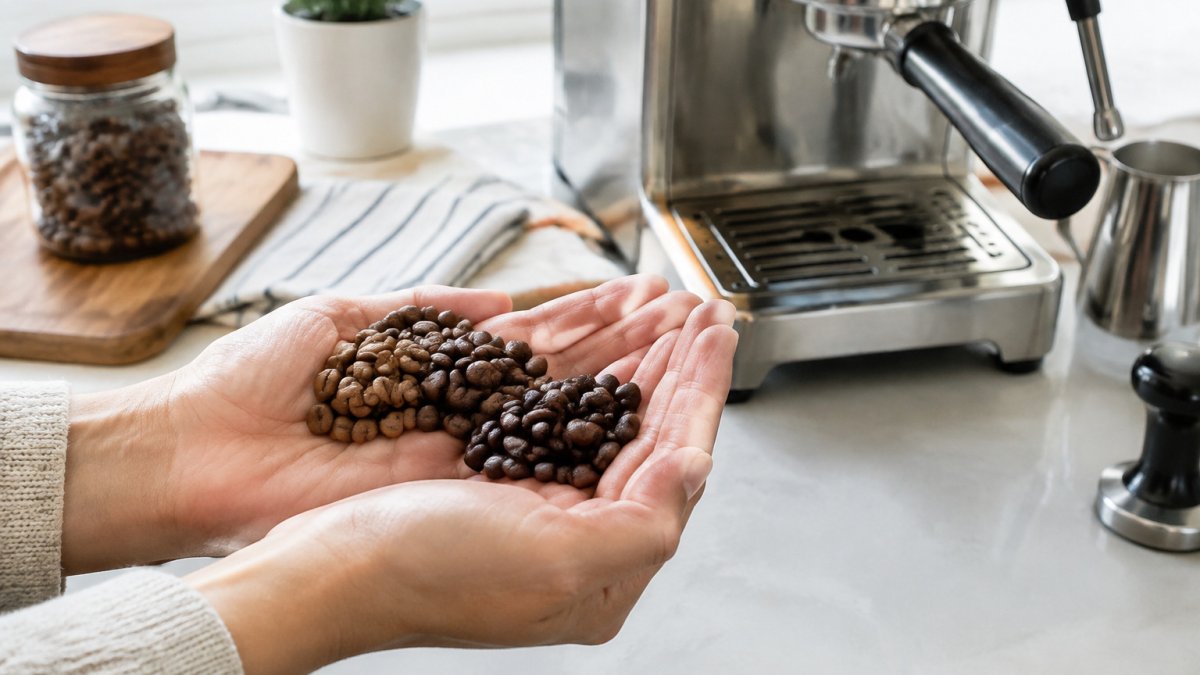
Roast level is the single biggest lever espresso beginners can pull before touching the grinder. It describes how long and how hot the beans were roasted, and it determines how easily the coffee gives up its flavor under espresso pressure. Understanding the four standard levels, light, medium, medium-dark, and dark, lets you predict what a bag will taste like and how forgiving it will be at the machine.
Light roasts are stopped shortly after first crack. They retain more of the bean's origin character: fruit acidity, floral notes, and tea-like body. Under espresso pressure, light roasts are dense and resist extraction, so they usually need a finer grind, a longer shot, or a higher brew temperature to avoid sour, thin results. They reward attention but punish sloppy technique.
Medium roasts sit past first crack but before second crack. Sugars have started to caramelize, acidity softens, and body thickens. This is the most forgiving zone for beginners because the coffee extracts evenly across a wide range of grind settings, small mistakes still produce a drinkable shot.
Medium-dark roasts reach the edge of second crack. Chocolate, caramel, and nutty notes dominate, body is full, and acidity is low. These roasts extract quickly and can turn bitter or ashy if the shot runs long, but they cut through milk better than lighter roasts and are a common default for milk-drink beginners.
Dark roasts are taken into or past second crack. Roasty, smoky, and bittersweet flavors take over, origin character fades, and the beans are porous and easy to extract. They are the most forgiving on grind but the least forgiving on time, a few extra seconds can push a dark roast from chocolatey to burnt.
A useful beginner rule: the lighter the roast, the more the grinder and shot time matter; the darker the roast, the more the shot time matters. Most espresso beginners land on medium to medium-dark because those roasts tolerate imperfect technique while still tasting sweet and balanced. If you want to explore light roasts, expect to spend a few shots dialing in; if you start dark, expect to shorten your shots to avoid bitterness.
How to Choose Espresso Beans as a Beginner
Start with the drink you make most often. If you mostly drink lattes and cappuccinos, a medium-dark blend with chocolate and nutty notes will cut through milk without tasting thin. If you prefer straight espresso, look for a medium roast with a clear sweetness.
Check the roast date before anything else. Coffee tastes best within a few weeks of roasting, and a bag with no date is a gamble. Our advice is to buy smaller bags more often rather than stocking up.
Avoid choosing purely by price or by bag design. Read the tasting notes and the origin information instead. Blends are usually easier for beginners because they are balanced by design, while single-origin coffees can taste sharp or unusual until you dial in your machine.
Espresso Beans vs Coffee Beans: What Actually Changes
Espresso beans are not a separate species. The difference is in the roast and the blend. Beans sold as espresso are typically roasted a little darker and blended to deliver consistent results under high pressure.
Regular filter or drip coffee usually shows off origin character more clearly, with lighter roasts that taste brighter and more delicate. Espresso compresses flavor into a small, concentrated shot, so roasts with body and sweetness tend to perform better.
You can brew espresso beans as filter coffee, but you will often find them heavy or bitter. Going the other way, a light single-origin filter coffee often tastes sour as espresso unless you adjust the grind and dose carefully.
The 7 Best Coffee Roasts for Espresso Beginners
These seven options are chosen for being forgiving, balanced and easy to enjoy from the first shot. Each one is a Fairwood Coffee bag, so you can compare them directly.
1. Blonde: Sweet Central American and African Blend
Blonde is a sweet blend from Central America and Africa, roasted to keep sugary notes intact. It is one of the most approachable options for someone who finds darker espresso harsh. Expect a clean, lightly fruity cup that works well as a straight shot or with milk.
Best for: beginners who want a sweet, bright shot. Skip if: you want deep chocolate or heavy body.
Blonde is available for $24.99 at Blonde.

2. Brazil Santos: Medium Roast With Cocoa Notes
Brazil Santos is a medium roast with an elegant, smooth cup and cocoa notes. The mellow profile makes it a dependable everyday espresso.
Best for: straight espresso drinkers who like smoothness. Skip if: you want a bold, dark punch in milk drinks.
You can view and order it at Brazil Santos.
3. Honduras: Medium-Dark With Caramel and Spice
Honduras is a medium-dark roast with caramel, spice and brown sugar notes. Grown in Marcala, La Paz, and fully washed before sun drying.
Best for: lattes and cappuccinos with a caramel note. Skip if: you prefer very light, fruity coffee.
4. Bali Blue: Medium-Dark With Dark Chocolate and Molasses
Bali Blue is a medium-dark single origin from Kintamani, Bali, with dark chocolate, molasses and brown sugar notes.
Best for: people who enjoy rich, dessert-like espresso. Skip if: you want a light, bright shot.
5. Latin American Blend: Medium-Dark With Nutty Hints
The Latin American Blend is a medium-dark roast of select Latin American coffees. It offers nutty hints, mild fruity tones and a gentle cocoa aftertaste, grown in Central American rain forests and volcanic soil near the Amazon.
Best for: an everyday blend that suits both straight and milk drinks. Skip if: you want a single origin with a distinct personality.
6. African Espresso: Medium-Dark Kenya, Tanzania and Ethiopia Blend
African Espresso blends coffees from Kenya, Tanzania and Ethiopia at a medium-dark roast. It is a good way to explore African character without the sharpness of a light roast.
Best for: beginners who want a little brightness with structure. Skip if: you dislike any tang in your espresso.
Available at African Espresso.

7. Decaf Espresso: Dark Roast Without the Caffeine
Decaf Espresso is a water-process decaf roasted dark for espresso. It is a practical option for evening shots or anyone reducing caffeine.
Best for: late-day espresso without the caffeine. Skip if: you want the sweetness of a lighter roast.
Find it at Decaf Espresso.

Best Medium Roast Coffee Beans for Espresso Compared
Medium and medium-dark roasts make up most of this list. The table below summarizes the main differences.
| Roast | Main Notes | Body | Best For |
|---|---|---|---|
| Blonde | Sweet, lightly fruity | Light to medium | Straight shots |
| Brazil Santos | Cocoa, smooth | Medium | Everyday espresso |
| Honduras | Caramel, spice | Medium | Milk drinks |
| Bali Blue | Dark chocolate, molasses | Medium-full | Rich, dessert-like shots |
| Latin American Blend | Nutty, mild fruit | Medium | All-round use |
| African Espresso | Bright, structured | Medium | Curious beginners |
| Decaf Espresso | Roasty, chocolate | Medium-full | Low caffeine |
Dialing In Your First Shots: Starting Settings for Each Roast
Every roast on this list needs a slightly different starting point. The numbers below are starting parameters, not targets, adjust by taste. Use a scale for dose and yield, and a timer for shot time. A common beginner baseline is 18 g in, 36 g out, in 25-30 seconds; the table below shifts that baseline for each roast.
| Roast | Starting shot time | Grind starting point |
|---|---|---|
| Blonde | 28-32 s | Fine |
| Brazil Santos | 25-30 s | Medium-fine |
| Honduras | 25-30 s | Medium-fine |
| Bali Blue | 24-28 s | Medium |
| Latin American Blend | 25-30 s | Medium-fine |
| African Espresso | 26-30 s | Medium-fine |
| Decaf Espresso | 22-26 s | Medium-coarse |
Starting shot time
Lighter roasts like Blonde need a finer grind and a longer yield to reach full sweetness; if the shot tastes sour and thin, grind finer in small steps and keep the yield steady. Medium roasts such as Brazil Santos and the Latin American Blend are the most forgiving, start at the baseline and adjust grind first. Medium-dark roasts like Honduras and Bali Blue extract quickly, so if the shot tastes bitter or ashy, coarsen the grind slightly or shorten the yield. African Espresso sits between medium and medium-dark; expect a little brightness and give it a slightly longer yield to balance the acidity. Decaf Espresso is porous and extracts fast, so start coarser and shorter than you would for a caffeinated dark roast.
Watch out: changing dose, grind, and yield at the same time makes it impossible to know which change fixed or broke the shot. Change one variable per shot, taste, and note the result.
A simple troubleshooting loop works for every roast: if the shot runs fast and tastes sour, grind finer; if it runs slow and tastes bitter, grind coarser; if it tastes weak but the time is right, increase dose slightly; if it tastes harsh but the time is right, decrease yield slightly. Keep the basket dose consistent and adjust grind in small increments, most beginners overshoot because they turn the grinder too far in one step.
For a step-by-step walkthrough, read How to Extract Espresso Step by Step at Home.
Choosing Your First Bag: Pick Your Roast and Order
Start with one medium or medium-dark roast that matches your drink preference, then move to a second bag once you understand how your machine behaves. Buying a single bag at first keeps the choice simple and helps you notice what you like.
If you drink mostly milk drinks, the Honduras or Latin American Blend are good first picks. If you prefer straight espresso, try Brazil Santos. For a sweeter first shot, Blonde is the easiest starting point. Skip the dark roasts until you are comfortable dialing in, unless you specifically want chocolate and roast intensity.
Fairwood Coffee offers these roasts at $24.99 per bag. Pick one and dial in your machine.
Frequently Asked Questions
What roast is best for espresso beginners?
Medium and medium-dark roasts are the most forgiving starting point. They extract evenly across a wide range of grind sizes and shot times, so small errors in dose or grind are less likely to produce a sour or harsh shot. Fairwood's Brazil Santos (medium) and Honduras (medium-dark) are good places to start, and the Blonde blend is a sweeter option.
Is medium or dark roast easier to use for espresso?
Medium roast is usually easier to dial in, because its origin flavors come through clearly and it tolerates small changes in grind. Dark roasts are more forgiving of under-extraction and produce a heavier body with less acidity, but they can taste bitter or ashy when pulled too long. Fairwood's Italian Roast is the darkest option in the range and is best suited to people who want a deep, heavy cup.
Can beginners use light-roast coffee for espresso?
They can, but light roasts are the hardest to dial in. They are dense and need finer grinds, higher temperatures and careful timing, so beginners often get sour, under-extracted shots. It is worth learning on a medium or medium-dark roast first, then moving to lighter coffees once you can control your dose, grind and shot time consistently.
How do I choose espresso beans without spending too much?
Start with one bag of a medium or medium-dark roast rather than buying several at once, and pick a blend or single origin that matches the flavors you enjoy, such as chocolate or caramel. Fairwood's espresso-focused bags are priced at 24.99 each, so one bag gives you a fixed cost to learn on. Buy beans roasted recently and use them within a few weeks for the best results.
