

7 Ways to Improve Coffee Extraction at Home
Table of Contents
- 1. Adjust Your Coffee Grind Size for Better Extraction
- 2. Perfect Your Coffee-to-Water Ratio for Home Brewing
- 3. Control Water Temperature for Coffee Extraction
- 4. Use Fresh, Quality Coffee Beans
- 5. How to Fix Sour Coffee Through Extraction Adjustment
- 6. Manage Brew Time and Contact Time
- 7. Distribute Grounds Evenly and Avoid Channeling
- Dial In Your Extraction: A One-Variable Workflow
- Frequently Asked Questions
Last Updated: October 18, 2026
1. Adjust Your Coffee Grind Size for Better Extraction
The most overlooked lever in home coffee brewing is grind size. It's the single fastest way to dial in flavor, yet many people treat their grinder as a set-it-and-forget-it tool.
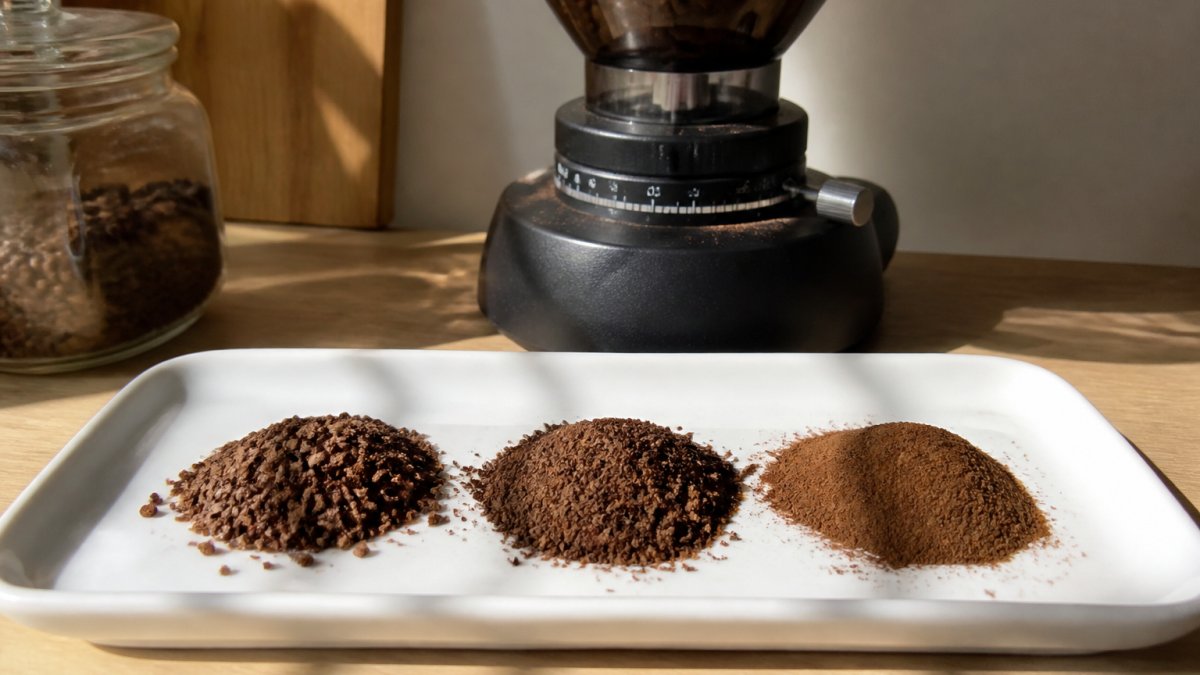
Grind size controls extraction speed. Coarser grounds have larger particles and more space between them, so water passes through quickly. Finer grounds pack tighter, slowing water flow and extending contact time. The goal is finding the sweet spot where you extract the flavors you want without pulling out bitter compounds.
Finding Your Sweet Spot: Coarse to Fine
Start by understanding where your brew method sits on the grind spectrum. French press and cold brew need coarse grinds because they use longer immersion times, water sits with the grounds for minutes. If you use a fine grind with a French press, you'll over-extract and end up with a harsh, muddy cup.
Espresso and filter coffee live at opposite ends. Espresso machines require fine, consistent grounds because water passes through in seconds. Filter coffee (pour-over, drip) uses medium grounds, faster than espresso but slower than French press.
The adjustment process is simple: brew a cup, taste it, and adjust. If your coffee tastes sour or thin, go finer. If it tastes bitter or harsh, go coarser. Move in small increments, a quarter turn on most grinders is enough to notice a change.
Grinder Consistency Matters
Not all grinders produce uniform particle size. Blade grinders chop randomly, creating a mix of dust and chunks. This inconsistency means some grounds over-extract while others under-extract, muddying your final flavor.
Burr grinders, whether flat or conical, crush beans between two surfaces, producing more uniform particles. This consistency is what separates a clean, bright cup from a muddy one. If you're serious about coffee extraction at home, a burr grinder is non-negotiable.
2. Perfect Your Coffee-to-Water Ratio for Home Brewing
The coffee-to-water ratio determines how strong or weak your final brew tastes. Get this wrong, and no amount of grind adjustment will save you. Most home brewers either use too little coffee (watery, under-extracted) or too much (over-concentrated, bitter).
A coffee-to-water ratio expresses how much coffee you're using relative to water. The standard starting point across most brew methods is 1:16, one part coffee to sixteen parts water by weight. This ratio produces a balanced cup for most people, though personal preference varies.
Starting Points for Common Brew Methods
| Brew Method | Starting Ratio | Typical Range | Why |
|---|---|---|---|
| Espresso | 1:2 to 1:3 | 1:2-1:3 | Short contact time requires concentrated dose |
| Pour-Over | 1:16 | 1:15-1:17 | Medium contact time, standard extraction |
| French Press | 1:15 | 1:14-1:16 | Longer immersion, slightly less water |
| Cold Brew | 1:4 to 1:5 | 1:4-1:6 | Extended steeping, concentrate-style |
| Aeropress | 1:16 | 1:15-1:17 | Flexible method, works across range |
Use a scale to measure both coffee and water. Eyeballing leads to inconsistency and frustration. If you brew 20 grams of coffee one day and 22 grams the next, you're changing your extraction without realizing it.
Start at 1:16 for filter coffee. Brew, taste, and adjust. If it tastes weak, reduce water (go toward 1:15). If it tastes harsh, add more water (go toward 1:17). Small adjustments, 0.5 grams of coffee or 10 milliliters of water, are enough to notice a difference.
3. Control Water Temperature for Coffee Extraction
Water temperature directly affects how fast extraction happens. Hotter water pulls flavor compounds out faster; cooler water does it slowly. Most home brewers either use water that's too hot (over-extraction, bitterness) or too cool (under-extraction, sourness).
The ideal range for filter coffee is 195-205°F (90-96°C). For espresso, aim for 200-205°F (93-96°C). These temperatures are hot enough to extract flavor efficiently but not so hot that they scald the grounds and pull out harsh, unwanted compounds.
Espresso vs. Filter Coffee Temperature Ranges
Espresso requires precise temperature control because the contact time is so short, water is in contact with grounds for only 25-30 seconds. Even a 5-degree difference changes extraction noticeably.
Filter coffee is more forgiving. Pour-over, Aeropress, and drip machines work well across a slightly wider range (190-210°F / 88-99°C). If your kettle isn't precise, aim for "just off boiling", let water boil, then wait 30 seconds before pouring.
If you don't have a thermometer, use this practical guide: water that's just off a rolling boil works for most filter methods. For espresso, if your machine has a group head thermometer, use it.
Cold brew breaks the temperature rule entirely. You're steeping grounds in room-temperature or cold water for 12-24 hours. The long contact time compensates for the low temperature, producing a smooth, less acidic concentrate.
4. Use Fresh, Quality Coffee Beans
Stale coffee is the silent killer of good extraction. Beans begin losing flavor compounds the moment they're roasted. After two weeks, they've lost significant brightness and complexity. After a month, they're noticeably flat.
Fresh beans extract more evenly because their cell structure hasn't degraded. Stale beans have broken down, which affects how water flows through them and what flavors end up in your cup.
Buy beans roasted within the last two weeks. Check the roast date on the bag, it should say something like "Roasted October 10, 2026." If there's no date, assume it's old.
Quality matters too. If you're serious about tasting what coffee extraction at home can do, try single-origin options like Fairwood Coffee's Ethiopia Natural or Tanzania, both showcase bright, complex flavors that reward proper extraction technique.

5. How to Fix Sour Coffee Through Extraction Adjustment
Sour coffee is almost always under-extracted. The water didn't stay in contact with the grounds long enough to pull out the full range of flavors. You're getting the bright, acidic notes without the balanced sweetness and body that come later in extraction.
Diagnosing Under-Extraction
Taste the sourness. Is it sharp and unpleasant, or bright and clean? Under-extracted coffee tastes thin, sour, and one-dimensional. You might also notice it tastes weak or watery.
Under-extraction happens for three reasons: grind too coarse, brew time too short, or water temperature too low. Fix it by adjusting one variable at a time.
Adjust grind size first. Go one notch finer on your grinder. Brew and taste. If it's still sour, go finer again.
If grind doesn't fix it, extend brew time. For pour-over, slow down your pour. For Aeropress, let the water sit longer before pressing.
Check water temperature last. If you're using water that's cooled significantly (below 190°F / 88°C), heat it hotter.
The workflow: adjust grind → brew → taste → repeat. Don't change multiple variables at once. You won't know which adjustment actually fixed the problem.
6. Manage Brew Time and Contact Time
Brew time is how long water sits with coffee grounds. It's the primary control for extraction alongside grind size. Longer contact time means more extraction; shorter contact time means less.
Different brew methods have different natural contact times. French press steeps for 4 minutes. Pour-over takes 2-3 minutes. Espresso is 25-30 seconds.
If your brew time is too short, you under-extract (sour, thin coffee). Too long, you over-extract (bitter, harsh).
For immersion methods like French press, brew time is straightforward: set a timer and press when it goes off. For pour-over and Aeropress, brew time is less precise because you control the pour rate.
Espresso machines have less flexibility. Shot time is typically 25-35 seconds from the moment water starts flowing. If your shot runs too fast (under 20 seconds), your grind is too coarse.
7. Distribute Grounds Evenly and Avoid Channeling
Channeling is what happens when water finds a path of least resistance through your grounds and rushes through, leaving most of the coffee under-extracted.
Channeling occurs when grounds aren't distributed evenly in your brew vessel.
For espresso: Distribute grounds evenly in the portafilter basket before tamping. Use a distribution tool or your finger to break up clumps and level the surface.
For Aeropress: Stir the grounds and water together after pouring. This breaks up clumps and ensures even saturation. Let it sit for 10 seconds, then stir again before pressing.
For pour-over: Pour slowly and in a circular motion. Avoid pouring all your water in one spot. Wet the grounds evenly, then continue pouring in concentric circles.
Uneven distribution is invisible until you taste the sourness. If you're doing everything else right but still getting sour coffee, suspect channeling.
Dial In Your Extraction: A One-Variable Workflow
Dialing in coffee extraction at home doesn't require perfection. It requires discipline: change one variable, brew, taste, repeat.
Here's the workflow we recommend:
Step 1: Start with standard ratios. Use 1:16 coffee-to-water ratio for filter coffee, 1:2 for espresso. Use fresh beans, 200°F water, and your grinder's medium setting. Brew and taste.
Step 2: Identify the problem. Does it taste sour (under-extracted) or bitter (over-extracted)? Or balanced? If balanced, you're done.
Step 3: Adjust grind only. If sour, go finer. If bitter, go coarser.
Step 4: Repeat step 3 until balanced. This typically takes 2-4 adjustments. Once you find your sweet spot grind, write it down.
Step 5: If grind doesn't solve it, adjust brew time. Extend contact time if sour, reduce it if bitter.
The goal isn't perfection, it's reproducibility. Once you can make the same cup twice, you understand your variables.
Fairwood Coffee's artisan blends are designed to reward this kind of precision. Our 6 Bean Blend works across multiple brew methods because the beans are chosen for balance and consistency.

The real payoff of understanding coffee extraction at home is tasting the difference. A properly extracted cup tastes clean, balanced, and complex.
Mastering coffee extraction at home transforms your daily routine from a convenience into a ritual. Our African Espresso blend showcases the brightness and body that proper extraction reveals.

Frequently Asked Questions
What grind size should I use to improve coffee extraction?
Grind size directly controls how fast water passes through ground coffee. Coarse grounds work best for cold brew and French press (longer contact time), while fine grounds suit espresso and Turkish coffee (shorter contact time). For filter coffee, use medium grounds. Start with your brew method's typical grind size, then adjust finer if your coffee tastes weak or sour, or coarser if it tastes bitter. Consistency matters as much as size: uneven particles create channeling, where water rushes through gaps instead of extracting evenly.
What water temperature is best for extracting coffee?
The best water temperature for coffee extraction ranges from 90-96°C for filter coffee and 88-92°C for espresso. Water that's too hot over-extracts, creating bitter, harsh flavors. Water that's too cold under-extracts, leaving your coffee sour and weak. If you don't have a thermometer, let boiled water cool for 30 seconds before pouring.
How does the coffee-to-water ratio affect extraction?
Your coffee-to-water ratio determines how much flavor is extracted from your grounds. A common starting point is 1:16 (1 gram coffee to 16 grams water) for filter coffee, and 1:2 to 1:3 for espresso. Stronger coffee requires more grounds relative to water; weaker coffee uses less. The ratio also affects extraction speed: higher ratios (more coffee) can lead to over-extraction if brew time isn't adjusted. Start with a consistent ratio, measure it on a scale, then adjust based on taste.
Why does my coffee taste sour, and how can I fix it?
Sour coffee signals under-extraction: water passed through too quickly, leaving acidic compounds behind. Fix it by grinding finer, increasing brew time, using hotter water, or adding more coffee grounds to your ratio. For espresso, sour pulls mean water moved through too fast; tamp harder, grind finer, or check for channeling. For filter coffee, try a finer grind or pour water more slowly. If sourness persists after adjusting these variables one at a time, switch to fresher beans or try a different origin. Fairwood Coffee's single-origin options like Ethiopia Natural or Tanzania can help you dial in the right extraction for each bean's unique profile.