

10 Essential Tools for a Professional Home Coffee Bar
Quick Summary
A professional home coffee bar depends on a small set of reliable tools, with consistency mattering more than the machine itself. The essentials are a tamper, a tamping mat with knock box, a coffee scale with timer, and a grouphead cleaning kit.
- Start with a tamper, scale with timer, and cleaning kit for the biggest gains in consistency.
- Weigh dose and yield by weight rather than volume, since grind density changes how much a scoop holds.
- Use a 1:2 ratio, such as 18 g in and 36 g out, in roughly 25-30 seconds as a starting point.
- Backflush the machine with plain water after each session to keep the grouphead clean.
Table of Contents
- What a Professional Home Coffee Bar Actually Needs
- 1. Tamper: Consistent Puck Preparation Starts Here
- 2. Tamping Mat and Knock Box for a Clean Workspace
- 3. Coffee Scale with Timer for Repeatable Doses and Shots
- 4. Portafilter Funnel, WDT Tool and Shot Glass
- 5. Grouphead Cleaning Kit and Maintenance Routine
- 6. Matching Tools to Your Brewing Method, Budget and Space
- 7. Booking Your Next Fairwood Coffee Order for Your Bar
- Frequently Asked Questions
What a Professional Home Coffee Bar Actually Needs
Last Updated: November 1, 2026
A professional-quality home coffee bar comes down to consistency, and consistency comes down to a small set of reliable tools. The gap between a bar that produces good espresso on a good day and one that produces it every morning is usually a missing tool, not a missing machine.
Most setup guides lead with the espresso machine. That's the wrong starting point. A capable machine with inconsistent dosing and uneven tamping will taste worse than a modest machine paired with a disciplined workflow. The tools below matter more than the price tag on the machine itself.
Our pick is a focused set of ten tools, ordered roughly by how much they affect the cup. Start at the top and work down as your budget and counter space allow.
| Tool | What It Controls | Priority |
|---|---|---|
| Tamper | Even puck density | Essential |
| Tamping mat and knock box | Clean workspace and waste disposal | Essential |
| Coffee scale with timer | Repeatable dose and shot time | Essential |
| Portafilter funnel | Clean, even dosing | Strongly recommended |
| WDT tool | Breaking up clumps before distribution | Strongly recommended |
| Shot glass | Measuring shot volume | Strongly recommended |
| Grouphead cleaning kit | Machine hygiene and flavor | Essential |
1. Tamper: Consistent Puck Preparation Starts Here
A tamper compresses the grounds in the portafilter into a level, even puck. Uneven compression lets water channel through weak spots, which produces sour and bitter shots at the same time. A tamper that fits your portafilter diameter and sits flat on the grounds is the first thing to get right.
Look for a flat base and a handle that sits comfortably in your palm. Consistency matters more than force: apply steady, level pressure every time. Pairing the tamper with a scale lets you see the dose you're working with.
2. Tamping Mat and Knock Box for a Clean Workspace
A tamping mat protects your counter and gives the portafilter a stable surface during tamping. A knock box holds spent pucks so you can empty the basket without making a mess. Together they keep the workspace clean enough that you can focus on the shot instead of cleanup.
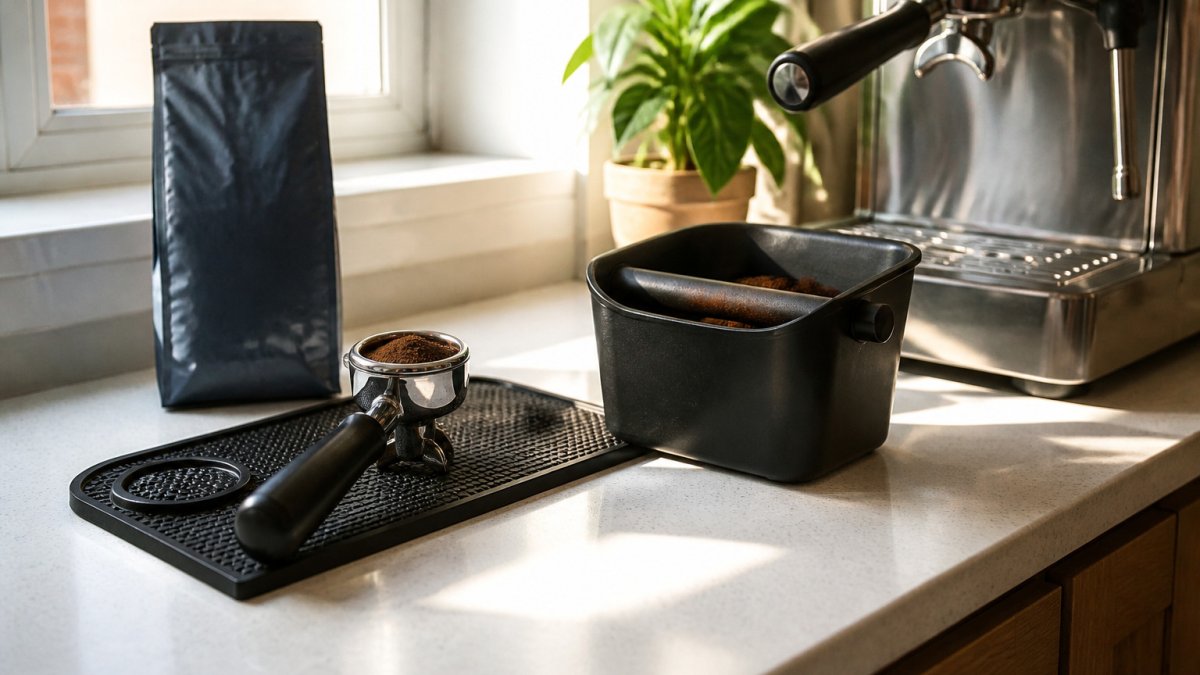
Empty the knock box regularly. Wet grounds left sitting in it can start to smell, and a crowded box makes the next knock less effective.
3. Coffee Scale with Timer for Repeatable Doses and Shots
A scale with a built-in timer is the tool that turns guesswork into a repeatable routine. Weigh the dose going in and the espresso coming out, then time the shot. Recording these numbers lets you adjust one variable at a time when a shot tastes off.
Dose by weight, not volume, because grind density changes how much a scoop holds.
4. Portafilter Funnel, WDT Tool and Shot Glass
These three tools cover the step between grinding and brewing, and each one solves a different failure mode. Treating them as a single upgrade is a common mistake: a funnel fixes mess, a WDT tool fixes clumping, and a shot glass fixes measurement. For more on grinding consistently, see Manual Coffee Grinders for Beginners: A Practical Guide. Skipping any one of them leaves a specific inconsistency in the workflow.
Portafilter funnel. A funnel sits on top of the basket and directs grounds into it without spilling. The practical benefit is dose accuracy: when grounds spill over the rim, you lose coffee you already weighed, and the next shot runs short. Funnels come in two main types. A tall dosing funnel gives you room to stir with a WDT tool before removing it; a low-profile funnel is easier to store but limits stirring space.
WDT tool. WDT (weiss distribution technique) uses fine needles to break up clumps in the grounds before tamping. Clumps are a leading cause of channeling, where water finds a weak path through the puck and produces sour and bitter notes in the same shot. A few seconds of gentle stirring in a circular motion, followed by a level tamp, often improves a shot more than changing the grind setting. Needle thickness matters: thinner needles (around 0.3-0.4 mm) disturb the puck less, while thicker needles are more aggressive.
Shot glass. A shot glass with clear volume markings lets you check output against your target. This is where measurement becomes calibration. A common starting point for espresso is a 1:2 ratio, 18 g dose in, 36 g yield out, in roughly 25-30 seconds. Weigh the output rather than eyeballing volume, because crema and temperature change how much space a given weight occupies. If the shot runs fast and tastes sour, grind finer; if it runs slow and tastes bitter, grind coarser. Change one variable at a time and record the result.
Workflow fit. Arrange these three tools in the order you use them: grinder, funnel, WDT tool, tamper, scale, shot glass. Keeping them in a fixed left-to-right or right-to-left sequence reduces reaching and spills. If counter space is tight, a single small tray that holds the funnel, WDT tool, and shot glass keeps the station organized and portable.
Compatibility notes. Before buying, confirm the funnel diameter matches your portafilter, check that the WDT needles fit inside the basket without scraping the sides, and choose a shot glass that fits under your machine's spouts. A glass that is too tall will not sit on the drip tray, and one that is too wide may not fit between the spouts.
5. Grouphead Cleaning Kit and Maintenance Routine
Coffee oils and old grounds can build up in the grouphead and shower screen. A cleaning kit with a brush and suitable cleaner helps keep the machine in working order.
Make cleaning a routine, not an occasional job. Backflush with plain water after each session and use a dedicated cleaner on a schedule that matches how often you brew. Check your machine's manual for recommended intervals.
6. Matching Tools to Your Brewing Method, Budget and Space
Not every home bar needs all ten tools on day one. The right order depends on what you actually drink, how much counter space you have, and what you want to spend. This section is a decision guide, not a shopping list.
Start with your drink menu. If you drink mostly espresso and milk drinks, prioritize the tamper, scale, funnel, and WDT tool. These four control dose, distribution, and extraction, the variables that decide whether a shot is consistent. A knock box and tamping mat come next for workflow and cleanup. If you alternate between espresso and pour-over, a scale and a gooseneck kettle matter more than a second tamper, because pour-over depends on controlled pouring and accurate ratios. If you brew mostly French press or batch brew, a scale and a good grinder do more for consistency than espresso-specific accessories.
Budget tiers. Think in three stages rather than one big purchase.
- Entry level: a scale with a timer, a tamper that fits your basket, and a cleaning kit. These three address the most common causes of inconsistent shots and machine hygiene.
- Midrange: add a funnel, a WDT tool, and a shot glass. This is where dose accuracy and distribution improve noticeably.
- Upgrade: add a dedicated tamping mat, a knock box, and a second tamper or basket if you change beans or brew styles often.
A common pattern is to spend first on the tools that affect the cup, then on tools that affect convenience.
Counter space and workflow. Measure your counter before buying. A compact bar can fit a grinder, machine, scale, and a small tray for the funnel, WDT tool, and shot glass. A knock box can live under the counter or on a lower shelf. If space is tight, choose a low-profile funnel and a compact scale that fits under the drip tray. Arrange tools in the order you use them to reduce reaching and spills.
Compatibility. Portafilter accessories depend on basket diameter, common sizes are 51 mm, 54 mm, and 58 mm. Confirm the tamper, funnel, and basket all match your machine before ordering. Check that your scale fits between the machine and the drip tray, and that your shot glass fits under the spouts. A tool that does not fit is not a bargain.
Measurable outcomes. Use the scale to track dose and yield, and use the shot glass to confirm volume. A starting point for espresso is a 1:2 ratio, 18 g in, 36 g out, in roughly 25-30 seconds. If the shot runs fast and tastes sour, grind finer; if it runs slow and tastes bitter, grind coarser. Change one variable at a time and record the result.
Once your tools are in place, your coffee supply is the next consistency decision. For a house blend suited to espresso, the 6 Bean Blend is a dark roast designed for that use. Readers who want to compare styles before committing can start with the Best Sellers Coffee Sample Pack, which includes six 2 oz coffees, including the 6 Bean Blend.

7. Booking Your Next Fairwood Coffee Order for Your Bar
Once your tools are in place, your coffee supply is the next consistency decision. Fairwood Coffee delivers artisan blends directly to your door. If you're still choosing a bean, the Single Origin Favorites Sample Pack gives you six 2 oz samples to test before committing to a full bag.
For a convenient alternative, our 12 Pack Single Serve Coffee Capsules offer a quick option for busy mornings. Choose the format that fits how you brew, and build your order around the tools you've set up.

Frequently Asked Questions
What equipment do you need to set up a home coffee bar?
Start with an espresso machine, a tamper, a coffee scale with timer, a knock box, a tamping mat and a grinder that produces consistent particles. Add a portafilter funnel and a WDT tool once you are dialling in shots regularly. A shot glass or scale-based yield check helps you measure output. Keep a grouphead cleaning kit within reach so the machine stays consistent. Build the set around your espresso habit first, then add milk and brewing tools as your drink menu grows.
Which coffee tools are worth investing in first?
A coffee scale with timer and a consistent tamper deliver the biggest improvement early on, because they control dose and puck preparation, the two variables most likely to change flavour from shot to shot. A knock box and tamping mat keep the workspace clean and protect counters. Accessories like WDT tools and funnels matter more once you already pull shots you want to repeat. Buy in that order and avoid spending heavily on decorative extras before the basics are reliable.
What tools does a home barista need to make espresso?
A home barista needs a dosing method, a tamper, a way to break up clumps before tamping, and a place to knock out spent grounds. A scale with timer helps you weigh the dose and track shot time, which makes results repeatable. A cleaning kit for the grouphead keeps extraction clean. Beginners can start with a basic tamper and scale and expand the set over time as their workflow settles.
How do you clean an espresso machine grouphead?
Backflush the machine with a blind filter and cleaning detergent according to the manufacturer's instructions, then rinse with clean water and wipe the grouphead and gasket. Remove the shower screen periodically to clear coffee residue, and clean the portafilter basket after each session. A dedicated brush helps reach gasket edges. Regular cleaning protects flavour and reduces the chance of channelling caused by blocked screens.
