

How to Store Artisan Coffee Beans: A Complete Guide
Table of Contents
- Why Proper Storage Matters for Artisan Coffee Freshness
- The Best Way to Store Coffee Beans
- Choosing the Right Coffee Bean Storage Container
- How Long Do Coffee Beans Stay Fresh
- Storing Coffee Beans in the Freezer for Extended Freshness
- Storage Enemies: Oxygen, Light, Heat, and Moisture
- Your Artisan Coffee Storage Plan: Buy Smart, Store Right
- Frequently Asked Questions
Last Updated: October 12, 2026
Why Proper Storage Matters for Artisan Coffee Freshness
Once roasted, artisan coffee beans begin losing flavor and aroma the moment air touches them, which is why you should store artisan coffee beans correctly to keep them fresh. Storing artisan coffee beans correctly keeps them fresh and delicious for weeks instead of days.
Fresh beans produce rich, complex flavors; stale beans taste flat and bitter. Most people don't realize their coffee went bad because they're used to drinking it that way.
The enemies of coffee freshness are simple to name:
- Oxygen breaks down flavor compounds
- Light degrades bean quality
- Heat speeds up staling
- Moisture causes mold and flavor loss
The Best Way to Store Coffee Beans
Storing coffee beans properly involves three core steps. Follow them and your coffee stays vibrant for weeks.
Step 1: Choose the Right Coffee Bean Storage Container
Your container does the heavy lifting. A bad container lets air in constantly. A good one seals tight and blocks light.
The best containers share three features:
- Airtight seal that actually works
- Opaque material (blocks light)
- Food-safe construction
Glass jars with rubber seals, ceramic containers with tight lids, and metal coffee canisters all work; what matters most is an airtight seal you use every time.
Avoid clear containers, containers that don't seal, and leaving beans in an original bag that doesn't seal properly.
Step 2: Find a Cool, Dark, Dry Location
Location matters as much as the container: even a sealed container won't help next to your stove.
The ideal spot is cool, dark, and dry, a pantry shelf or cupboard away from appliances. Avoid heat sources, stoves, ovens, dishwashers, and direct sunlight.
Temperature should stay between 60-70°F if possible; consistency matters more than exact temperature, since fluctuations cause condensation inside the container.
Humidity matters too: a damp kitchen is worse than a cool one, so pick the driest spot you can find.
Step 3: Seal and Label Your Beans
Sealing matters more than most people think: take out what you need and seal the container immediately, never leaving it open while you brew.
Label your container with the roast date. Beans roasted within the last two weeks are ideal; more than four weeks ago, they're past their prime.
If your container has no label, write the date on tape and stick it on, you'll be glad when deciding whether to brew or buy fresh.
Choosing the Right Coffee Bean Storage Container
The container you pick shapes how well your beans stay fresh, so understanding the trade-offs helps you choose the right one.
Airtight Containers vs. Original Packaging
Original coffee packaging often includes a one-way valve that lets carbon dioxide escape without letting air in, which works reasonably well for short-term storage.
Airtight containers are better for long-term freshness: they seal completely, block light better than most bags, and store beans for weeks without quality loss.
The trade-off: they cost more upfront, take up shelf space, and require transferring beans from the original bag.
For most enthusiasts an airtight container is worth it; if you drink coffee quickly and buy small quantities, original packaging works fine.
Container Material and Design Comparison
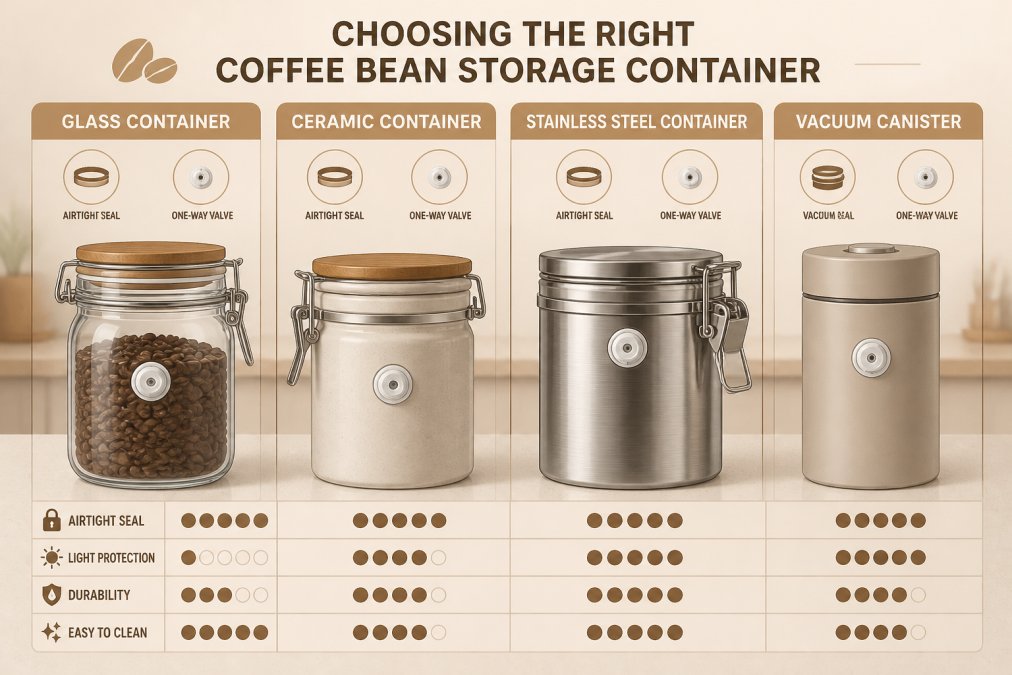
Not all airtight containers are equal: material and design affect light protection, seal quality, convenience, and headspace. Here's how common options compare.
Stainless steel canisters block light completely, resist odors, and are durable, typically using a silicone gasket and clamp or twist seal.
Original bags with one-way valves are convenient and often block light if opaque, but their tin-tie or zipper seals aren't truly airtight after opening.
Vacuum containers actively remove air and can extend freshness, but add complexity and cost, and the pumping routine gets tedious.
What to prioritize:
- Light protection: opaque or stored in the dark
- Seal quality: silicone gasket, locking mechanism, or true vacuum
- Convenience: easy to open and close daily, easy to clean
- Headspace: choose a size that minimizes empty air above the beans
Understanding One-Way Degassing Valves
A one-way valve is a small mechanism on coffee bags and some containers. It lets carbon dioxide escape without letting oxygen in.
Freshly roasted beans release CO2 for several days; if it can't escape, pressure builds inside the bag, and if oxygen gets in while gas escapes, the beans oxidize faster.
A one-way valve solves both problems. It lets CO2 out. It blocks oxygen from getting in.
Most quality coffee bags and many premium containers include this valve. If yours doesn't, an airtight seal still works, just make sure it's truly airtight.
How Long Do Coffee Beans Stay Fresh
Beans gradually lose flavor and aroma over time, so knowing when they're past their prime helps you decide when to brew and when to buy fresh.
Freshness Timeline by Roast Level
Roast level affects how quickly beans fade: light roasts stay fresh longer than dark roasts because darker roasting accelerates the natural breakdown process.
Light roasts: 3-4 weeks, developing more complexity over the first 7-10 days before gradually fading.
Medium roasts: 2-3 weeks, at their best within the first two weeks.
Dark roasts: 1-2 weeks, fading faster but developing bold flavors quickly.
These timelines assume proper storage; without it, all roasts fade within days.
The roast date matters more than the purchase date. If you don't know it, ask your supplier.
Signs Your Coffee Beans Have Gone Stale
Stale beans show clear signs; learning to spot them tells you when to buy fresh.
Stale beans look dull instead of shiny, smell flat instead of aromatic, and taste thin and bitter instead of complex and smooth.
If the aroma isn't strong when you open the container, the beans are fading; if the coffee tastes sour or flat, they're past their prime.
The easiest test: smell the beans. Fresh beans smell amazing; stale beans smell like cardboard.
Storing Coffee Beans in the Freezer for Extended Freshness
Freezing extends freshness significantly. But freezing requires the right approach. Done wrong, it damages beans more than it helps.
When Freezing Makes Sense
Freezing helps if you buy large quantities you can't drink quickly, or want to preserve beans from a special roast.
It's not ideal for everyday coffee: it adds complexity and requires careful handling to avoid moisture damage.
But for long-term storage of 2-3 months or longer, freezing is your best option.
The Freezer Method: Step-by-Step
Freezing beans properly takes a few minutes:
-
Portion your beans into small amounts. Divide into portions you'll use within one or two weeks, since each thaw forms condensation.
-
Use airtight freezer bags or containers. Regular bags let freezer burn in; remove as much air as possible before sealing.
-
Label with the roast date and freeze date so you know how old they are when you thaw them.
-
Freeze immediately. Don't leave beans at room temperature while preparing them; the faster they freeze, the better.
-
Thaw in the sealed container. Leave it on the counter for 30 minutes to prevent condensation forming on the beans.
-
Use within one week of thawing. Once thawed, beans fade quickly.
The key is minimizing air exposure and preventing condensation. Done right, frozen beans taste nearly as good as fresh; done wrong, they taste like the freezer.
Storage Enemies: Oxygen, Light, Heat, and Moisture
Understanding what damages coffee helps you protect it, each enemy requires a different defense.
Oxygen is the biggest threat, breaking down flavor compounds and creating stale taste.
Light degrades beans as it fades colors: UV light breaks down aromatic compounds.
Heat speeds up the chemical processes that make beans stale.
Moisture causes mold and flavor loss, and humid kitchens damage beans faster than dry ones.
The best approach addresses all four at once: an airtight, opaque container in a cool, dry, dark location.
Your Artisan Coffee Storage Plan: Buy Smart, Store Right
A storage plan keeps your coffee consistently fresh. The key is matching how much you buy and how you store it to how quickly you drink it.
A Measurable Freshness and Usage Plan
Start by estimating your daily consumption:
- One 12-ounce cup uses about 0.7 to 0.9 ounces of whole beans (roughly 20 to 25 grams).
- A 12-ounce bag (340 grams) makes about 14 to 17 single cups.
- If you drink two cups a day, a 12-ounce bag lasts about one week.
Use this to decide how much to buy:
- If you drink 1-2 cups per day: Buy a 12-ounce bag every 1-2 weeks. Store in an airtight container in a cool, dark place. Use within 2-4 weeks of the roast date for best flavor.
- If you drink 3-4 cups per day: Buy a 1-pound bag (16 ounces) every 1-2 weeks. Consider splitting it: keep one week's worth in your daily container and freeze the rest in portions.
- If you drink less than 1 cup per day: Buy smaller bags (8-12 ounces) more often, or freeze half of a larger bag immediately in small portions.
Storage duration ranges (assuming an airtight, opaque container in a cool, dark, dry place):
- Peak freshness: 5-14 days after roast date for most roasts.
- Good drinking: 2-4 weeks after roast date.
- Past prime but usable: 4-8 weeks after roast date; flavor flattens and bitterness may increase.
- Frozen: 2-3 months for best quality; up to 6 months is often acceptable but flavor may decline.
Signs of staleness:
- Beans look dull instead of slightly shiny (especially medium and dark roasts).
- Aroma is weak or smells like cardboard, paper, or hay.
- Brewed coffee tastes flat, sour, or bitter without complexity.
- Espresso crema dissipates very quickly.
A simple routine: write the roast date on your container, check the aroma when you open it, and if it's not vibrant, finish those beans soon or replace them.
Buy Smart, Store Right
Buy in small quantities. Don't buy more than two weeks' worth unless freezing; when you store artisan coffee beans in smaller batches, you ensure fresher coffee on average.
Check the roast date. Ask your supplier when beans were roasted; within the last week is ideal.
Label everything. Write the roast date and opening date on your container to see at a glance how fresh your beans are.
Brew within two to four weeks. Most beans are at their best in this window; after that they're drinkable but fading fast.
Freeze for longer storage. If you can't use beans within four weeks, freeze them in small portions.
This plan takes five minutes to set up and zero to maintain.
Frequently Asked Questions
How long do roasted coffee beans stay fresh after opening?
Roasted artisan coffee beans typically stay fresh for 2-4 weeks after opening when stored properly in an airtight container in a cool, dark place. The exact timeline depends on roast level: lighter roasts retain freshness longer than darker roasts. Once opened, beans begin losing flavor as carbon dioxide escapes and oxygen enters. For maximum freshness, use beans within the first 2 weeks after opening. Check your roast date on the package and consume beans within 4 weeks of that date.
Should you store coffee beans in the freezer?
Freezing works for long-term storage of whole beans you won't use immediately, but it requires careful technique. Seal beans in an airtight container and freeze for up to 3-4 months. The key is avoiding condensation: let frozen beans reach room temperature before opening to prevent moisture damage. Freeze only whole beans, never pre-ground coffee. Use freezing strategically when you've purchased more than you can use within 4 weeks, not as your primary storage method.
What is the best container for storing artisan coffee beans?
An airtight container with a tight seal is essential. Look for options with rubber gaskets, locking mechanisms, or resealable strips. Opaque containers (glass or ceramic) work better than clear ones since they block light. If your artisan beans come in original packaging with a one-way degassing valve and resealable strip, that original bag often provides adequate short-term storage. For longer storage, transfer beans to a dedicated airtight canister. Avoid containers that allow air exchange or let light through.
How should you store artisan coffee beans to keep them fresh?
Store whole artisan beans in an airtight container in a cool, dark, dry place away from heat sources like ovens, stoves, and direct sunlight. Keep beans away from humidity and temperature fluctuations. A pantry or cupboard works well. Minimize headspace in your container to reduce oxygen exposure. Buy in quantities you'll use within 2-4 weeks, and check the roast date before purchasing. If storing longer than a month, freeze beans in a sealed container and thaw at room temperature before opening.