

Why Artisan Coffee Tastes Better: A 2026 Guide
Table of Contents
- Why Artisan Coffee Tastes Better: The Science and Craft
- Artisan Coffee vs Grocery Store Coffee: What Sets Them Apart
- Coffee Roast Date and Freshness: Why Timing Matters
- How to Store Coffee Beans for Maximum Flavor
- How to Brew Artisan Coffee at Home Like a Professional
- The Psychology Behind Why Artisan Coffee Tastes Better
- Frequently Asked Questions
Last Updated: October 7, 2026
Why Artisan Coffee Tastes Better: The Science and Craft
The difference between a cup of grocery store coffee and artisan coffee isn't subtle. One tastes flat, stale, and forgettable. The other has complexity, brightness, and character. This isn't marketing speak, it's chemistry and craft working together.
Why artisan coffee tastes better comes down to a handful of concrete factors: how the beans are sourced, roasted, stored, and ultimately brewed. Each step compounds. A fresh bean handled poorly still underperforms. A quality bean treated with precision delivers something genuinely different. At Fairwood Coffee, we've built our entire operation around this principle: the best coffee requires attention to every detail.
The gap between artisan and mass-market coffee is measurable. It starts at the source and widens with every decision made afterward. Understanding why that gap exists, and how to close it on your own, changes how you think about coffee entirely.
Artisan Coffee vs Grocery Store Coffee: What Sets Them Apart
Grocery store coffee and artisan coffee operate under completely different constraints and priorities. Mass-market producers optimize for shelf stability, consistency across millions of units, and cost efficiency. Artisan roasters optimize for flavor, freshness, and the specific characteristics of each bean's origin.
This difference shows up in the cup immediately. Grocery store coffee tastes generic because it's engineered to offend no one. Artisan coffee tastes specific because it's engineered to express something, the terroir of the region, the particular processing method, the roast profile chosen to highlight certain flavor compounds.
Grind Consistency and Extraction
Extraction is where coffee's flavor compounds dissolve into water. The consistency of your grind determines how fast this happens. A fine, uniform grind extracts quickly. A coarse, inconsistent grind extracts unevenly. Artisan coffee demands grind consistency because inconsistent particles lead to channeling, water flowing through gaps in the coffee bed instead of through the grounds themselves.
Grocery store coffee often comes pre-ground, which means it's already oxidizing. It sits in that tin for months. By the time you brew it, the grind consistency has degraded and the beans have lost volatile aromatic compounds. Artisan coffee is typically sold whole bean. You grind it fresh, moments before brewing. The grind particles remain uniform and the aromatic compounds stay intact until they hit the water.
A burr grinder, not a blade grinder, is non-negotiable here. Burr grinders produce consistent particle size. Blade grinders produce dust and chunks. If you're serious about why artisan coffee tastes better, this is where the investment pays off.
Water Temperature and Brew Ratio
Water temperature controls extraction rate. Too cold and you under-extract. Too hot and you over-extract. The sweet spot for most brewing methods is 195-205°F (90-96°C). This range allows the right solubility of flavor compounds without pulling out harsh tannins and excessive bitterness.
Brew ratio, the ratio of coffee to water, determines strength and body. A common starting point is 1:16 (one part coffee to sixteen parts water). Adjust from there based on your preference and the specific bean. Artisan roasters often provide brewing recommendations because they've dialed in what works for their specific roast profile.
Grocery store coffee drinkers often use whatever water temperature comes out of the tap and guess at the amount of coffee. The result tastes muddy or thin. Precision here isn't obsessive, it's the difference between a mediocre cup and a good one.
Coffee Roast Date and Freshness: Why Timing Matters
Freshness is where artisan coffee delivers its biggest advantage. Coffee beans start degassing immediately after roasting. This process peaks around day 3-5 after roast and gradually slows. A bean roasted two weeks ago is still in its prime. A bean roasted six months ago has lost most of its volatile compounds.
Grocery store coffee has no roast date printed on the package. You have no way to know if it was roasted last month or last year. Artisan roasters stamp the roast date on every bag. This transparency exists because freshness matters to the flavor profile. A fresh bean tastes bright and complex. A stale bean tastes flat and one-dimensional.
The psychology of freshness also plays a role. When you know your coffee was roasted days ago, not months ago, you approach it differently. You're more likely to grind it fresh, brew it with care, and actually taste what's in the cup. That ritual, that intentionality, changes the experience.
How to Store Coffee Beans for Maximum Flavor
Storage determines how quickly your beans degrade. Oxygen, light, heat, and moisture are coffee's enemies. Each one accelerates the loss of flavor compounds and the development of stale, cardboard-like notes.
The best storage is airtight, opaque, and cool. A sealed container in a dark cabinet works. Avoid the freezer, the temperature fluctuations introduce moisture. Avoid clear glass jars on the counter, light degrades the beans and you're advertising your coffee collection to anyone who walks by. Buy whole beans in quantities you'll use within two to three weeks. Freshness compounds over time.
Fairwood Coffee ships fresh-roasted beans directly to you, which means you're never buying stale coffee. The beans arrive within days of roasting, and you control how long they sit before brewing. This eliminates the longest part of the traditional supply chain, the time coffee spends in warehouse, on truck, and on store shelf.
How to Brew Artisan Coffee at Home Like a Professional
Brewing artisan coffee at home doesn't require expensive equipment. It requires precision and intention. The difference between a good cup and a great cup often comes down to technique, not gear.
Precision Brewing: Bloom, Contact Time, and Flow Rate
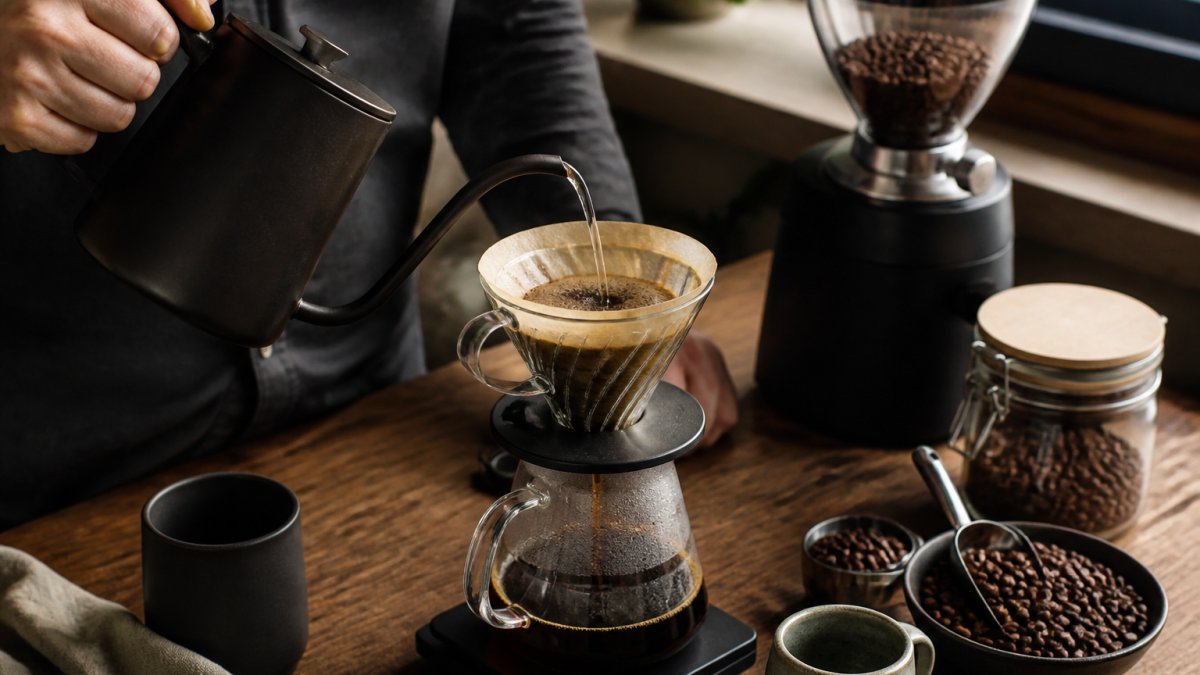
The bloom is the first 30-45 seconds of brewing. You pour just enough hot water to saturate the grounds, usually about twice the weight of the dry coffee. During the bloom, CO2 escapes from the grounds and water begins to penetrate the bean.
Single Origin Favorites Sample Pack →
Contact time is how long the water sits with the grounds. For pour-over methods, this is typically 3-4 minutes. For immersion methods like French press, it's 4-5 minutes. Too short and you under-extract. Too long and you over-extract.
Flow rate is how fast the water moves through the grounds. A faster flow rate reduces contact time and produces a lighter cup. A slower flow rate increases contact time and produces a fuller cup.
Most people skip the bloom, use random contact times, and never think about flow rate. That's why their coffee tastes inconsistent. Artisan coffee demands this attention because the beans are too good to waste through careless brewing.
Budget-Friendly Professional Hacks
You don't need a $400 espresso machine to brew excellent coffee. A pour-over cone, a gooseneck kettle, and a burr grinder cost less than $100 combined and produce coffee that rivals anything from a cafe. The gooseneck kettle matters because it gives you control over pour rate and bloom saturation. The burr grinder matters because it produces consistent particle size. The pour-over cone matters because it forces you to slow down and pay attention.
Another hack: use a kitchen scale. Weighing your coffee and water removes guesswork. A scale costs $15-30 and is the single best tool for consistency. Once you know the exact ratio that works for you, you can reproduce it every single time.
Pre-heat your brewing vessel with hot water before you brew. This prevents heat loss and ensures your water stays at the right temperature throughout the brewing process. It's a 10-second step that measurably improves extraction.
The Psychology Behind Why Artisan Coffee Tastes Better
Here's what most coffee guides miss: some of why artisan coffee tastes better is literal chemistry. Some of it is neurogastronomy, the science of how the brain constructs flavor from taste, smell, sight, and context. And some of it is the ritual effect, a measurable shift in perception that occurs when coffee is prepared and served with intention.
Neurogastronomy: Your Brain Builds the Flavor
Flavor is not a property of the coffee. It is a construction your brain assembles from multiple streams of sensory data. The tongue detects five basic tastes, sweet, sour, salty, bitter, and umami. The olfactory system detects hundreds of volatile aromatic compounds. The trigeminal nerve registers texture, temperature, and astringency.
This matters because up to 80% of what you perceive as flavor actually comes from retronasal olfaction, aromatic compounds traveling from the back of your mouth up into your nasal cavity. When you swallow, those volatiles hit the olfactory epithelium and your brain merges them with what your tongue is reporting.
Artisan coffee delivers more volatile aromatic compounds because it is fresher, roasted to preserve them, and brewed to extract them. But the brain also amplifies the effect through expectation. When you see a roast date, read tasting notes, or watch a barista weigh beans, your brain primes itself to detect complexity. This is not placebo.
The Ritual Effect: Dopamine, Anticipation, and Perceived Quality
The act of preparing or being served coffee is not separate from the taste. It is part of the taste. Anticipation triggers dopamine release in the nucleus accumbens, and dopamine does not just signal reward, it sharpens attention to reward-related cues. When you grind fresh, bloom the grounds, and pour in a slow spiral, you are building a 3-4 minute anticipation window.
Cafe service exploits this deliberately.
You can replicate this at home without buying anything. Use a cup you actually like. Sit down. Do not check your phone during the brew. Smell the grounds before you add water. Smell the bloom. Smell the finished cup before you taste it. These are not affectations, they are sensory priming steps that measurably increase the number of aromatic compounds your brain registers.
Why This Compounds With the Chemistry
The chemistry and the psychology are not competing explanations. They are layers. A stale grocery store bean brewed carelessly and gulped on autopilot loses on every layer: fewer volatiles, no priming, no anticipation, no attention. A fresh artisan bean brewed with precision and consumed with intention wins on every layer: more volatiles, stronger priming, a dopamine-heightened anticipation window, and full attention during consumption.
The same bean brewed carelessly tastes flat. The same bean brewed with precision and served with ritual tastes alive. That gap is not imaginary. It is the difference between drinking coffee and tasting it.
Frequently Asked Questions
What makes artisan coffee taste better than grocery store coffee?
Artisan coffee tastes better due to several factors: freshness (roasted within weeks rather than months), precise grind consistency that optimizes extraction, careful water temperature control, and single-origin beans with distinct flavor profiles. Grocery store coffee often sits on shelves for months, losing volatile flavor compounds. Artisan roasters also source beans from specific regions and altitudes, emphasizing terroir, how soil, climate, and elevation shape tasting notes like berry, chocolate, or floral qualities.
How does roast date and freshness affect artisan coffee flavor?
Coffee begins degassing immediately after roasting and reaches peak flavor 3-10 days post-roast, depending on roast level. Within 2-4 weeks, volatile aromatic compounds dissipate, reducing complexity and acidity. Grocery store coffee may be 3-6 months old, resulting in flat, stale flavors. Check the roast date on your bag, if it's missing or older than a month, freshness has likely declined.
How should you store artisan coffee beans to keep them fresh?
Store beans in an airtight container away from light, heat, and moisture. A sealed glass jar in a cool, dark cupboard works well. Avoid the freezer unless storing for 3+ months; condensation damages flavor. Keep beans whole rather than pre-ground, ground coffee loses freshness within days due to increased surface area. Buy only what you'll use in 2-4 weeks. Proper storage preserves the solubility of flavor compounds and maintains the acidity and body you paid for.
Can you brew artisan coffee at home as well as a café?
Yes, with the right approach. Home brewing requires three elements: fresh, properly ground beans, precise water temperature (195-205°F), and correct brew ratio (typically 1:16 to 1:18 coffee to water by weight). Control contact time, how long water touches the coffee bed, to avoid under-extraction (weak, sour) or over-extraction (bitter). A burr grinder, scale, and gooseneck kettle are affordable investments. Many professionals use simple pour-over or French press methods at home, proving expensive equipment isn't necessary for excellent results.