

Manual Coffee Brewing Equipment: A 2026 Guide
Table of Contents
- Why Manual Coffee Brewing Equipment Matters for Home Coffee Enthusiasts
- Manual Coffee Brewing Methods for Beginners: Getting Started
- Best Manual Coffee Grinder for Home Brewing
- Manual Pour Over vs French Press: Which Method Fits Your Routine
- Essential Factors to Consider When Buying Manual Coffee Equipment
- Sustainability and Long-Term Cost of Manual Brewing Equipment
- Troubleshooting Common Extraction Issues and Channeling Problems
- How to Pair Equipment and Artisan Coffee Blends for Best Results
- Frequently Asked Questions
Last Updated: October 2, 2026
Why Manual Coffee Brewing Equipment Matters for Home Coffee Enthusiasts
Manual coffee brewing equipment gives you control over every variable that affects extraction, water temperature, bloom phase, pour rate, and brew time, transforming coffee from a background beverage into something worth your attention.
The result is cleaner flavor, better body, and the ability to highlight what makes each artisan blend unique. Manual brewing requires intention, not expertise.
Manual Coffee Brewing Methods for Beginners: Getting Started
Manual brewing falls into two main categories: pour-over and immersion brewing, each producing distinct flavor profiles.
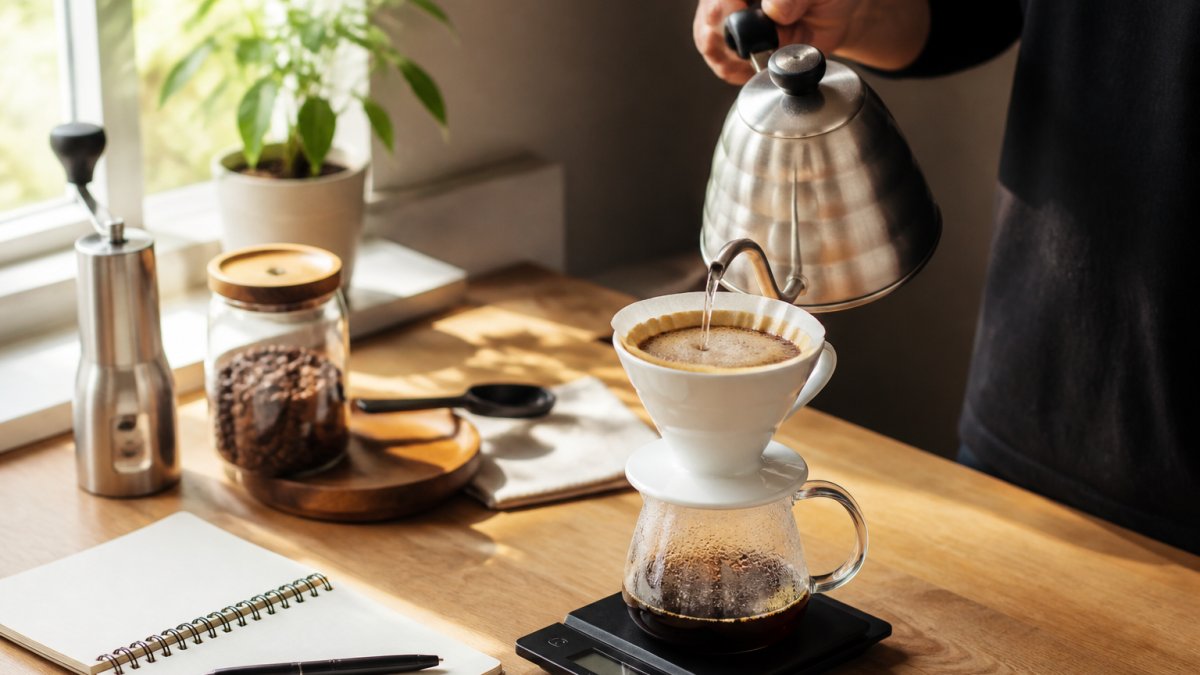
Pour-over brewing basics
Pour-over brewing is the most accessible entry point.
Start with a simple pour-over cone. Rinse the filter paper with hot water, then saturate the grounds and let them sit 30-45 seconds (bloom phase).
Pour-over requires attention and minimal equipment, but you can't set it and walk away.
Immersion brewing with a French press
French press steeps grounds directly in hot water, then you press a metal filter down to separate them.
French press is forgiving, add grounds, pour hot water, wait 4 minutes, press, and pour. The trade-off: oils that create richness mute subtle notes in lighter roasts.
Single-serve options for quick results
Single-serve brewers like the Aeropress (air pressure through paper filter) or Moka pot (stovetop heating) deliver strong coffee in under 5 minutes.
These suit people with limited counter space or those who travel, and they're ideal for experimenting without committing to larger equipment.
Best Manual Coffee Grinder for Home Brewing
The grinder matters more than the brewing method. A quality manual coffee grinder determines whether you extract the full potential from your beans or end up with bitter, under-extracted coffee.
Burr type: conical vs. flat mechanisms
Conical burrs are more forgiving of inconsistent pressure and produce fewer fines (ultra-fine particles that over-extract), generating less heat. Flat burrs produce more uniform particle size but generate more heat and require consistent pressure.
For manual brewing, conical burrs are the better choice, they're more tolerant of technique variation.
Grind size adjustment and consistency across brewing methods
Manual grinders must offer precise, repeatable grind size adjustment. Look for grinders with numbered settings (typically 15-40 positions) that let you dial in a specific size and return to it reliably. This matters because different brewing methods require different grind sizes:
- Pour-over (medium grind): Roughly the texture of sea salt. Allows water to flow through in 3-4 minutes without channeling.
- French press (coarse grind): Larger particles that steep for 4+ minutes without over-extracting. Too fine, and you'll get sediment in your cup.
- Aeropress (fine-medium grind): Finer than French press but coarser than espresso. The air pressure compensates for finer particles.
- Moka pot (fine grind): Similar to espresso grind. The heat and pressure require smaller particles for proper extraction.
A quality manual grinder lets you move between these settings without guessing. If you're switching between a pour-over and French press, you need a grinder where you can dial from setting 20 to setting 8 and trust that the grind size matches.
Thermal stability and grinding duration
Grinding generates friction heat. Extended grinding sessions heat the burrs and the beans, which can degrade volatile flavor compounds and affect extraction.
For larger quantities (40+ grams) or multiple grinds in succession, stainless steel burrs are the practical choice, more durable than ceramic and they conduct heat away faster.
Matching grinder capacity to your brewing routine
Hopper size affects grinding time and usability. A 20-gram hopper takes 2-3 minutes per cup; a 50-gram hopper takes 5-8 minutes for a full batch. Mid-sized hoppers (30-40 grams) offer the best balance of speed, consistency, and practicality.
Grinder-to-brewer compatibility
Verify that your grinder can produce the grind size your brewing method requires. A versatile grinder lets you experiment with different methods without buying multiple grinders.
Manual Pour Over vs French Press: Which Method Fits Your Routine
The choice between manual pour over and French press comes down to three factors: flavor preference, time available, and cleanup tolerance.
Extraction differences and flavor outcomes
Pour-over produces a cleaner cup with more acidity and brightness. French press keeps oils, creating heavier body that emphasizes richness. Lighter roasts shine in pour-over; darker roasts in French press.
Brew time, water temperature, and technique
Pour-over takes 3-4 minutes and requires active pouring (195-205°F water). French press takes 4-5 minutes and is mostly passive (190-210°F water). Choose based on your morning routine and whether you prefer ritual or convenience.
Essential Factors to Consider When Buying Manual Coffee Equipment
Before investing in manual brewing gear, evaluate these practical considerations. They determine whether your equipment becomes a daily ritual or an unused novelty.
Carafe capacity and batch brewing needs
Manual brewers range from single-serve (8-10 oz) to full-batch (30+ oz). Single-serve equipment suits people who brew one cup at a time.
Carafe capacity also affects water temperature stability. Smaller vessels cool faster, which matters if you're particular about serving temperature.
Filter paper, stainless steel, and durability
Filter type affects both flavor and convenience. Paper filters remove oils and create a cleaner cup but generate waste.
Durability depends on material. Glass carafes look elegant but break easily. Stainless steel is durable but doesn't let you see brew progress.
Sustainability and Long-Term Cost of Manual Brewing Equipment
Manual equipment lasts years with proper care. Mesh filters are reusable indefinitely, while paper filters create ongoing waste. A basic pour-over cone costs under $20 and lasts decades; a quality burr grinder costs more upfront but eliminates electric grinder replacement.
Troubleshooting Common Extraction Issues and Channeling Problems
Extraction problems are the most common complaint from people new to manual brewing. Understanding what went wrong helps you adjust and improve next time. The key is learning to diagnose the problem by taste, then making targeted adjustments rather than changing everything at once.
Identifying extraction problems by taste
Coffee that tastes wrong falls into two categories: under-extracted (sour, thin, weak) or over-extracted (bitter, harsh, astringent). Identifying which one you have is the first step to fixing it.
Taste your coffee immediately after brewing. If it's sour, you're under-extracting. If it's bitter, you're over-extracting. This diagnosis guides your next adjustment.
Extraction troubleshooting table
Use this table to diagnose and fix extraction problems systematically. Start with your diagnosis (sour or bitter), then try the adjustments in order of likelihood:
| Problem | Most Likely Cause | First Adjustment | Second Adjustment | Third Adjustment |
|---|---|---|---|---|
| Sour taste (under-extracted) | Grind too coarse | Use finer grind | Increase brew time by 30 sec | Raise water temp by 5°F |
| Sour taste (under-extracted) | Brew time too short | Increase brew time by 30-45 sec | Use finer grind | Raise water temp by 5°F |
| Sour taste (under-extracted) | Water temperature too low | Raise water temp by 10°F | Increase brew time by 30 sec | Use finer grind |
| Bitter taste (over-extracted) | Grind too fine | Use coarser grind | Decrease brew time by 30 sec | Lower water temp by 5°F |
| Bitter taste (over-extracted) | Brew time too long | Decrease brew time by 30-45 sec | Use coarser grind | Lower water temp by 5°F |
| Bitter taste (over-extracted) | Water temperature too high | Lower water temp by 10°F | Decrease brew time by 30 sec | Use coarser grind |
Channeling: the most common pour-over problem
Channeling occurs when water finds the path of least resistance through grounds instead of flowing evenly, resulting in sour, under-extracted coffee. The fix is prevention:
-
Distribute grounds evenly before pouring. Tap the dripper gently on the counter to settle grounds, then use a finger or small spoon to level the surface. Uneven ground distribution is the #1 cause of channeling.
-
Use a gooseneck kettle for better pour control. A regular kettle pours too quickly and in too large a stream, making it hard to pour slowly and evenly. A gooseneck kettle's thin spout lets you control flow rate precisely.
-
Pour in slow, circular motions. Start from the center and spiral outward, then spiral back inward. This ensures even water distribution across all grounds. Pour slowly enough that you can see water flowing through the grounds, not rushing.
-
Avoid pouring directly on the filter paper. Water should contact grounds, not run down the sides of the dripper. If water is running down the sides, you're pouring too fast or too close to the edge.
Sediment in French press: a different problem
French press produces sediment if the grind is too fine. Use a coarser grind, press more firmly, or leave the last half-inch of liquid in the pot where sediment collects.
Adjusting one variable at a time
Change only one variable per brew so you know which adjustment worked. Start with the most likely fix, taste, and evaluate before making the next adjustment.
How to Pair Equipment and Artisan Coffee Blends for Best Results
The final step is matching your equipment to the right coffee. Not all brewing methods suit all roasts equally.
Light roasts highlight acidity and floral notes, use pour-over.
Fairwood Coffee's artisan blends are roasted with specific brewing methods in mind. Check the tasting notes: clarity and complexity suggest pour-over; body and richness suggest French press.
Manual coffee brewing equipment transforms your relationship with coffee. The ritual, the control, and the flavor improvements make the small investment worthwhile.
Frequently Asked Questions
What equipment do I need to start manual coffee brewing at home?
To begin manual coffee brewing, you need a brewing device (pour-over dripper, French press, or Aeropress), a manual or burr grinder, filter paper or reusable filters, a gooseneck kettle for controlled pouring, a scale for accurate coffee-to-water ratios, and hot water. Start with one brewing method and add equipment as you develop your preferences. Artisan coffee blends from quality sources like Fairwood Coffee work best when paired with proper equipment that allows you to control extraction and water temperature.
Is manual coffee brewing better than automatic machines?
Manual brewing offers more control over extraction, bloom phase, water temperature, and flow rate, which often produces more complex flavor profiles and better acidity balance. Automatic machines sacrifice this precision for convenience. Manual brewing suits those who enjoy the process and want to highlight the nuances of artisan blends, while automatic machines work better for busy routines. The choice depends on whether you prioritize flavor development or speed.
How do manual pour-over and French press brewing methods differ?
Pour-over uses filter paper to create a cleaner cup with brighter acidity and lighter body by controlling flow rate and extraction time. French press uses immersion brewing with a metal filter, resulting in fuller body and more mouthfeel but potentially more sediment. Pour-overs require more technique and attention to water temperature and bloom phase, while French presses are more forgiving. Choose pour-over for delicate artisan blends and French press for fuller-bodied coffees.
What makes a good manual grinder for home coffee brewing?
A quality manual grinder should have a burr mechanism that delivers consistent grind size, thermal stability to avoid overheating the beans, and adjustable settings to match your brewing method. Burr grinders outperform blade grinders because they produce uniform particle size, which directly affects extraction and prevents channeling. Look for stainless steel construction and a design that lets you control grind consistency from fine espresso grounds to coarse cold brew sizes.