

Is Manual Coffee Brewing Worth the Effort?
Last Updated: October 30, 2026
Quick Summary
Manual coffee brewing is worth the effort if you enjoy a hands-on routine and want control over flavour. It costs more active minutes than an automatic machine, but the process becomes repeatable once you build a routine.
- Manual brewing gives you full control over grind size, water temperature and pour rate.
- Automatic brewers cost more up front, and their price rises with added features.
- A single pour-over needs a few minutes of active attention for grinding, pouring and cleanup.
- Manual results are inconsistent until you build a routine, but the learning curve is one-time.
- Test your routine for one week and note how often you reach for the automatic machine.
Table of Contents
- What Manual Coffee Brewing Actually Involves
- Manual Coffee Brewing Pros and Cons
- Manual vs Automatic Coffee Brewing: Time, Cost and Control
- Does Manual Brewing Make Coffee Taste Better?
- Manual Coffee Brewing Equipment for Beginners
- How Much Manual Coffee Brewing Time to Expect
- Choosing Your Next Brew With Fairwood Coffee
- Frequently Asked Questions
What Manual Coffee Brewing Actually Involves
Manual coffee brewing means you control every variable yourself: grind size, water temperature, the coffee-to-water ratio, and how long the water contacts the grounds. A simple pour-over is a common starting point, because the steps are easy to repeat and the results show quickly. The trade-off is that you do the work an automatic machine does for you, every single morning.
A typical pour-over routine looks like this: weigh the beans, grind them just before brewing, heat the water, bloom the grounds with a small pour, then pour in slow circles until you reach your target weight. Each step takes seconds, but together they demand attention. That is the core question this article answers: is the attention worth it?
Manual Coffee Brewing Pros and Cons
The main advantage of manual brewing is control. You decide how strong the cup is, how fast the water flows, and when to stop. That control lets you adjust one variable at a time and taste the difference, which is how most people learn what they actually like.
The drawbacks are just as real. Manual methods take longer, need more cleanup, and depend on consistency. Two mornings with slightly different pouring speeds can produce two noticeably different cups. Many people also find the ritual satisfying, while others find it tedious after a few weeks.
- Pros: full control over flavour, low equipment cost, a repeatable process you can refine, and no electricity needed.
- Cons: more time and attention per cup, a learning curve, and inconsistent results until you build a routine.
Best for: people who enjoy hands-on routines and want to understand what changes the taste of their coffee. Skip if: you need a fast, identical cup every weekday before a commute.
Manual vs Automatic Coffee Brewing: Time, Cost and Control
Most comparisons stop at "manual gives you control, automatic gives you speed." That is true, but the practical question is what each approach costs in money, minutes, and attention over a year of daily brewing. The practical question is what each approach actually costs you in money, minutes, and attention over a year of daily brewing.
Total cost of ownership, not sticker price
Automatic brewers front-load the cost. A drip machine or automatic pour-over brewer costs more up front, and the price climbs quickly once you add features like a built-in grinder, thermal carafe, or programmable timer. That higher entry price buys convenience, not necessarily better coffee.
Ongoing costs differ in kind rather than amount. Manual brewing consumes paper filters (or none, with a reusable metal or cloth filter) and the coffee itself. Automatic machines consume electricity, and many need descaling solution or replacement water filters over time. Neither approach is dramatically cheaper per cup once you account for beans, but manual setups have fewer parts that can break and no electronics to replace.
Time and attention per cup
The time difference is real but often overstated. A manual pour-over asks for a few minutes of active attention from grinding through the final pour, plus cleanup. An automatic brewer asks for a few seconds of loading and pressing a button, then you walk away. The gap is not hours, it is the difference between being present for your coffee and not.
Attention is the hidden cost. Manual brewing does not let you multitask during the pour; you are watching the bed, the flow, and the clock. Automatic brewing lets you shower, answer email, or pack lunches while the machine works. For commuters and households with tight mornings, that attention cost matters more than the minutes.
Control and repeatability
Control is where manual brewing clearly pulls ahead. You can change water temperature, pour rate, or grind size in a single cup to test a theory, and you feel the difference immediately. Automatic machines offer limited adjustment, often just a strength setting or a grind selector, so you accept their results.
Repeatability cuts the other way. A well-made automatic brewer produces the same cup every time because it controls the variables for you. Manual brewing is repeatable only after you build a routine; two mornings with slightly different pouring speeds can produce two noticeably different cups. The trade-off is control versus consistency, and which one you value depends on whether you drink coffee to explore or to fuel a routine.
The table below sums up how manual and automatic brewing compare on the points that matter most over a year of daily coffee.
| Factor | Manual brewing | Automatic brewing |
|---|---|---|
| Up-front cost | Lower, with few parts | Higher, rising with added features |
| Active time per cup | A few minutes of attention | A few seconds, then you walk away |
| Control over variables | Full control over each variable | Limited to strength or grind settings |
| Repeatability | Consistent only after you build a routine | Same cup every time |
| Ongoing costs | Filters and coffee | Electricity, descaling and replacement filters |
| Parts that can break | Few | More, including electronics |
Does Manual Brewing Make Coffee Taste Better?
Manual brewing does not automatically produce better coffee. A carefully dialled-in automatic machine can match a manual cup. What manual brewing offers is the chance to tune the flavour toward what you prefer, and that tuning is often where the improvement comes from.
Quality starts with the beans. Our Brazil Santos is a medium roast with an elegant, smooth cup and cocoa notes. Our Ethiopia Natural, a medium-light roast, brings milk chocolate and fruity, caramel flavours. If you want to test your technique, learn how to master pour over coffee at home with a step-by-step method.
Manual Coffee Brewing Equipment for Beginners
You need four basics: a dripper or brewer, paper filters, a gooseneck or regular kettle, and a scale. A burr grinder is a useful upgrade because grind consistency affects flavour. Picking your first brewer can feel overwhelming, so compare French Press and AeroPress for beginners before you buy.
Our guide to manual coffee grinders for beginners explains what to look for, from burr type to grind adjustment range.
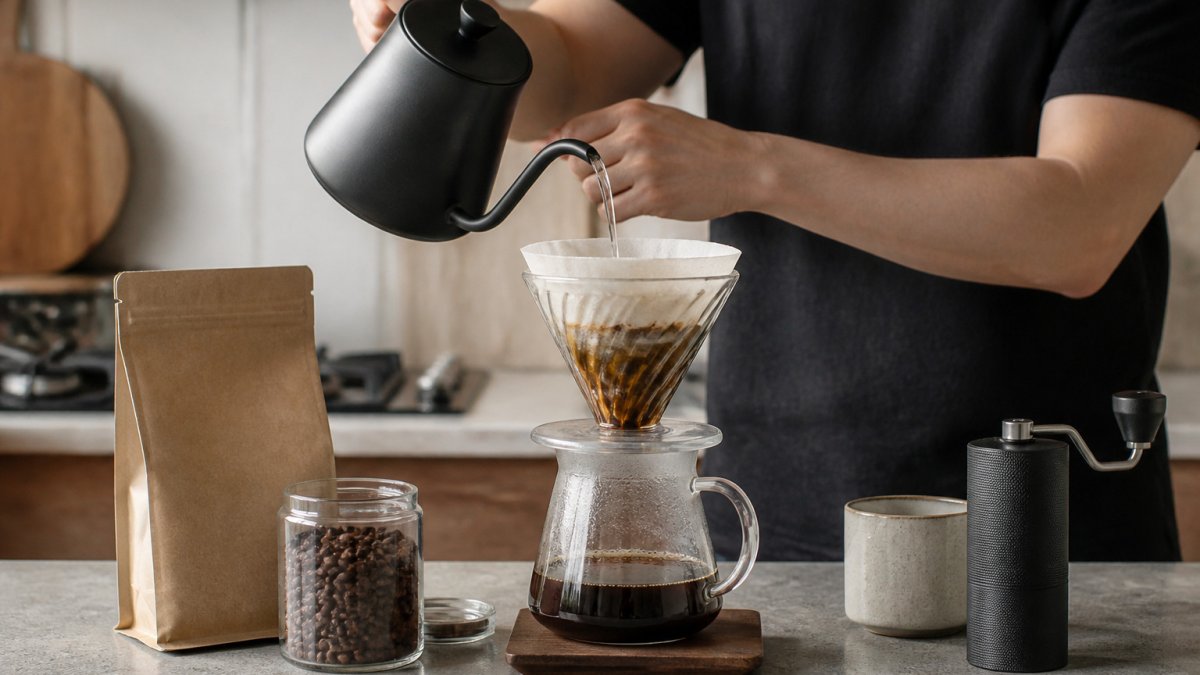
Hands pouring hot water in a slow circular motion over a pour-over dripper on a kitchen counter, with a bag of coffee beans and a gooseneck kettle nearby.
How Much Manual Coffee Brewing Time to Expect
"Worth the effort" is really a question about time. The honest answer is that manual brewing costs more active minutes than automatic brewing, but less than most people fear once a routine is in place. Breaking the process into stages makes the trade-off concrete.
A realistic time breakdown for one cup
A typical single-cup pour-over breaks down roughly like this:
- Weighing and grinding beans: under a minute with a hand grinder, faster with an electric burr grinder.
- Heating water: a few minutes, but this is passive time you can spend on something else, and an electric kettle with a temperature setting removes the guesswork.
- Blooming and pouring: a few minutes of active attention, since you are watching the bed and controlling the pour.
- Cleanup: rinsing the dripper and filter, dumping grounds, and wiping the counter, usually a minute or two.
The active time, the part where you cannot walk away, is the grinding, pouring, and cleanup. The passive time is the water heating. Automatic brewing collapses the active time to seconds but still requires you to load grounds and, later, clean the carafe and basket.
The learning curve is front-loaded
The first few weeks feel slower because you are learning the pour rhythm, the grind setting, and the timing. The learning curve is not a permanent tax; it is a one-time investment that pays back in repeatable results.
Matching the method to your routine
The time cost is not the same for every manual method. A French press is forgiving and low-attention; an AeroPress is fast and easy to clean; a pour-over demands the most attention during the pour. If time is your main concern, choose a method that matches your patience on a bad morning, not your enthusiasm on a good one.
A useful test: brew manually for one week and note how often you reach for the automatic machine instead. That pattern tells you more about whether manual brewing is worth the effort than any general recommendation.
Choosing Your Next Brew With Fairwood Coffee
If you decide manual brewing is worth the effort, start with a sample so you can compare before committing. Our Best Sellers Coffee Sample Pack gives you six 2 oz coffees, from the Breakfast Blend to the Bali, so you can see which flavours you prefer. For a single origin to test your technique, the Single Origin Favorites Sample Pack covers six origins in small packs.
Once you know what you like, Fairwood Coffee delivers artisan blends straight to your door. Manual brewing is worth the effort when you enjoy the process and taste the results, and a sample pack is a practical way to find out.
Frequently Asked Questions
Is manual coffee brewing worth the effort?
It depends on what you value. Manual brewing takes longer, usually several minutes of active work per cup, and asks you to manage grind size, water temperature and the coffee-to-water ratio yourself. In return you get direct control over each variable and a cup you can adjust from one brew to the next. If you drink one cup a day and enjoy the ritual, the effort is usually worth it. If you need a fast cup before a commute, an automatic machine or a Fairwood Coffee sample pack to compare blends may serve you better.
Are manual coffee machines better than automatic coffee makers?
Manual methods are not automatically better. They give more control over extraction, which lets you tune flavor, but they also depend on your technique. An automatic machine delivers repeatable results with less attention, which suits busy mornings. The better choice depends on whether you want to adjust each cup or simply want a consistent one with minimal effort.
How much time does manual coffee brewing take?
Most manual brews take between three and six minutes of active time, plus grinding and cleanup. Pour-over and French press methods typically sit at the upper end because of bloom time and steeping. Grinding fresh beans adds a few minutes but has a large effect on flavor. Plan on about ten minutes from start to finish for a careful first cup, and less once you have a routine.
What equipment do you need to start brewing coffee manually?
A starter setup needs a burr grinder, a scale for measuring coffee and water, a brewer such as a pour-over dripper or French press, and a kettle that lets you control pour speed or temperature. Fairwood Coffee's Colombia and Ethiopia Natural single origins are available, and the Best Sellers Coffee Sample Pack lets you compare six roasts before committing to a full bag.
